

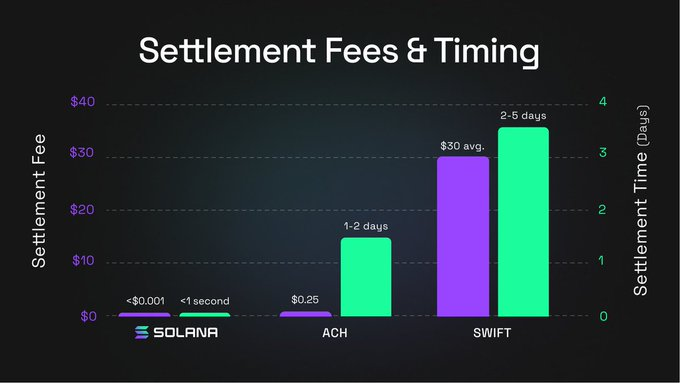
If speed is a priority when moving crypto, Solana transfers are tough to beat. Onchain SOL transactions typically confirm in under a second and reach full finality in around 13 seconds, making it one of the fastest digital assets to send.
That said, a few factors can affect the actual process. Here's what you need to know about how long Solana transactions take and what affects that speed.
Solana is purpose-built for speed. With a block time of roughly 400 milliseconds and average confirmation times of under one second, it ranks among the most performant blockchains in operation today. Full transaction finality is reached in approximately 13 seconds.
So how long do Solana transactions take? For direct wallet-to-wallet transfers, settlement can feel near-instant, but a few key factors shape the real-world experience.
Solana's speed stems from a clever pairing of consensus mechanisms. The PoS vs PoW debate is central to understanding why — where Proof of Work requires miners to compete through energy-intensive computation, Solana's Proof of Stake foundation selects validators to propose and attest to blocks, eliminating that overhead entirely. Proof of History then acts as a cryptographic clock, timestamping transactions before they hit the blockchain and eliminating the time validators would otherwise spend agreeing on event ordering.
Solana can theoretically handle up to 65,000 transactions per second (TPS), though real-world throughput typically sits between 1,500 and 4,000 TPS. During peak events such as a major NFT drop or a viral token launch, congestion can create transaction delays. Even so, Solana absorbs traffic spikes far better than Ethereum or Bitcoin thanks to its high TPS limit.
Solana's fees average just a fraction of a cent, well below Ethereum's often unpredictable gas costs. Unlike Ethereum's priority fee model, where paying more can accelerate processing, Solana's fees are based on computational resource usage, keeping costs stable regardless of demand.
Your on-chain Solana transfer may settle in seconds, but exchanges add their own processing layer before a transaction ever reaches the network. Fraud detection, compliance checks, and liquidity management all introduce delays. Under normal conditions this takes a few minutes but during high-volume periods, it can be considerably longer.
Solana has experienced occasional outages and slowdowns, though these have become less frequent as the network has matured. In rare cases, they can temporarily halt processing entirely. If you're seeing unexpected delays, checking Solana's status page is a useful first step.
Solana is substantially faster than both major rivals. Bitcoin transactions can take anywhere from 10 to 60 minutes to fully confirm, and Ethereum averages around 12–15 seconds per block. Solana, by comparison, settles most transfers in under a second— a difference that matters enormously for trading, payments, and real-time applications.
Looking at Solana vs Bitcoin also shows how newer blockchain designs prioritize throughput over the slower confirmation model used by earlier networks. For a more in-depth look at how Solana compares to more modern blockchains, check out our guide on Solana vs. Ethereum.
for rich media - Added as a quick reference from link on X
Once you've initiated a Solana transfer, you can monitor its progress in real time using a block explorer. The two most widely used tools are Solana Explorer and Solscan.
To check the status of your transaction, paste either your wallet address or your transaction signature into the search bar of either explorer. You should then see whether the transaction is:
Confirmed is generally regarded as sufficient for smaller everyday transfers but for larger, more sensitive transactions, waiting for Finalized is the safer choice. If a transaction seems stuck, the explorer will also show any errors or failed states.
Explore the full range of Solana use cases to see why speed matters so much across the ecosystem and understand more about what Solana can do.
Solana uses commitment levels — Processed, Confirmed, and Finalized — rather than a traditional confirmation count. Most exchanges credit deposits at Finalization, which takes around 13 seconds. Each platform sets its own policy, so exact requirements vary. Check your exchange's documentation for specifics.
This blog post is for informational and educational purposes only and does not contain all information pertinent to an investment decision. Solana Company is not an investment company and an investment in it does not provide the protections of the Investment Company Act of 1940. Nothing in this blog post constitutes an investment recommendation or an offer of investment advisory services. This blog cannot be relied upon in making an investment decision. Nothing contained herein constitutes an offer to sell, or a solicitation to buy, any securities. None of the Solana Company or any of its affiliates or advisors accepts any liability for losses in connection with the acquisition, holding, or disposition of any asset, including Solana or the securities of any company. There is no assurance that following steps or other information referenced here will be effective in transacting any financial instrument. This blog post contains information believed to be reliable, and has been obtained from sources believed to be reliable, but Solana Company makes no representation or warranty (express or implied) of any nature, nor accepts any responsibility or liability of any kind, with respect to the fairness, accuracy, completeness, or reasonableness of the information or opinions contained herein. There is no guarantee that investments in any company, instrument, or type of instrument described herein will be profitable – all investments carry the inherent risk of total loss. Analyses and opinions contained herein (including market commentary, statements or forecasts) reflect the judgment of Solana Company as of the date this blog was published, and may contain elements of subjectivity (including certain assumptions) or be based on incomplete information. There is no duty or obligation to update the contents of this blog post. This blog post is not intended to provide, and should not be relied on for accounting, legal, or tax advice, or investment recommendations. There is no guarantee that investments in any instrument or type of instrument described herein will be profitable – all investments carry the inherent risk of total loss.









© 2025 solana company. All Rights Reserved.
.svg)