

Solana has emerged as one of the fastest and most cost-effective blockchains in crypto with about $55.8 billion staked on the network today. Whether you're managing your own wallet or investing through Solana proxies like $HSDT stock, Solana staking is a way to potentially earn yields that could far outperform traditional savings accounts, all while supporting the network.
In this blog we’ll look at what staking Solana is, how it works, and how it can help you generate extra income. Keep in mind that investments always carry the risk of loss, which is discussed more in disclosures at the end of this post
Solana staking is the process of committing your SOL tokens to help validate transactions and maintain the blockchain's integrity. When you stake, you're essentially vouching for a validator's trustworthiness by backing them with your tokens. In return for this support, the network rewards you with additional SOL—think of it like earning interest, but on a blockchain instead of at a bank.
Unlike traditional proof-of-work blockchains, such as Bitcoin, that require energy-intensive mining, Solana uses a proof-of-stake (PoS) consensus mechanism combined with its unique proof-of-history (PoH) technology. This combination allows the network to process transactions at remarkable speeds while keeping fees low—making staking an attractive option for developers building applications and investors looking to grow their holdings through staking.
Proof-of-Stake is the consensus mechanism designed to keep Solana secure without requiring massive computing power. Instead of miners competing to solve complex puzzles, PoS relies on validators who are chosen to confirm transactions based on how much SOL is backing them.
On Solana, when you stake SOL, you delegate your tokens to these validators, effectively casting a vote of confidence in their ability to keep the network running smoothly. The more stake a validator has, the more frequently they're selected to process transactions, and the more rewards they generate for their delegators.
When you stake your SOL, you retain full ownership of your tokens—the validator never has direct control over staked Solana. Your SOL becomes "locked" in a stake account, meaning you can't spend or transfer it while it's actively earning rewards. However, this lock-up isn't permanent.
You can unstake at any time, though there's a brief cooldown period before your tokens become available for the traditional staking method. For liquid staking tokens, you can immediately unstake or lend your tokens to others in the liquidity pool. For traditional staking, rewards accumulate automatically based on network conditions and validator performance. Those with high uptime and low commission rates typically generate better returns. For liquid staking tokens, the value of the token increases as the pool increases.
Staking Solana gives you a nice mix of financial perks and network-wide benefits, whether you’re holding for the long run or staying active in the ecosystem. Here are just a few:
But even with all these benefits, staking also comes with a few things to keep in mind.
Even though staking is straightforward, there are certain risks and trade-offs every delegator should be aware of.
Knowing these risks and how it could affect your rewards can help you pick the right staking setup for you.
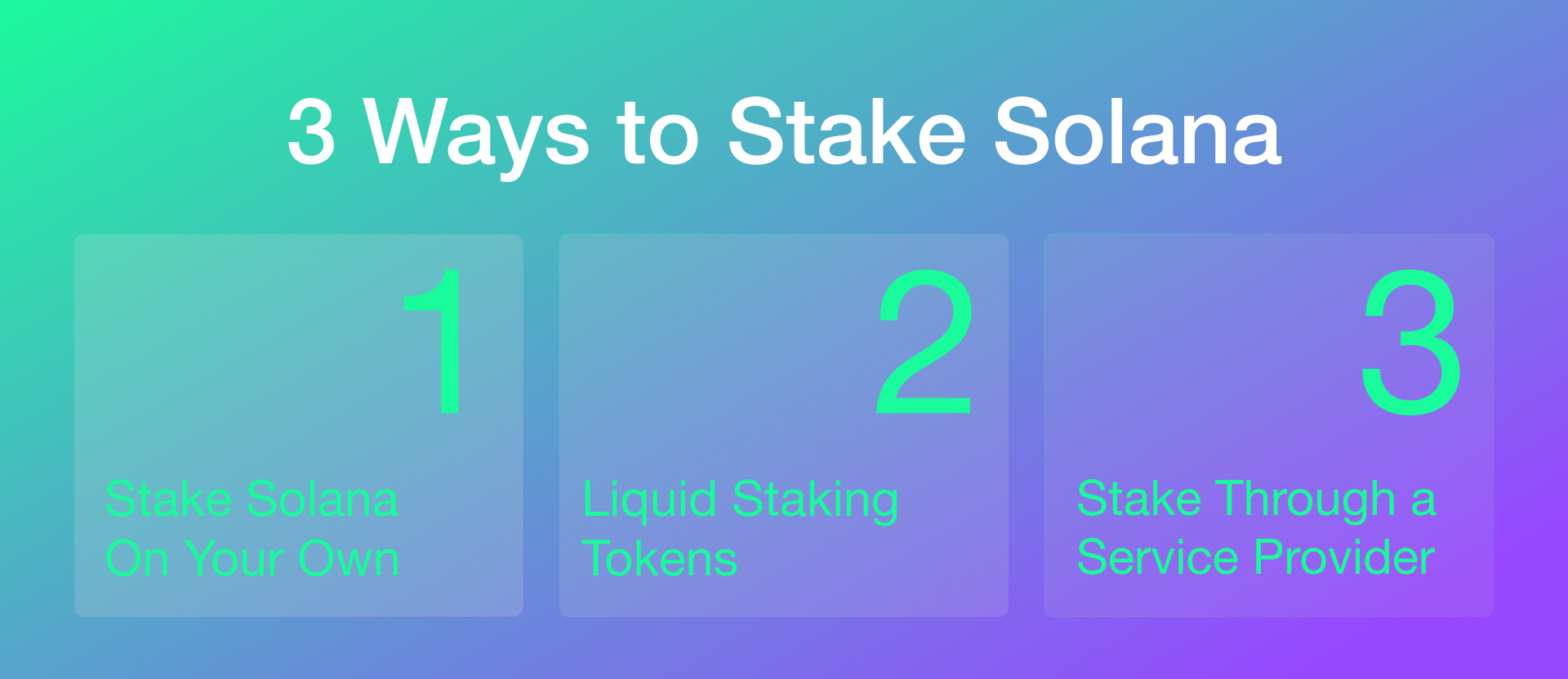
When it comes to what does staking Solana mean in practical terms, you have two main paths: doing it yourself through a wallet or letting a service provider handle it. Both approaches earn you staking rewards, but they differ significantly in time commitment, technical knowledge required, and overall convenience.
DIY staking gives you complete control over every aspect of the process. You'll need a Solana-compatible wallet (Phantom, Solflare, and Ledger are popular choices), some SOL to stake, and a willingness to research validators. The minimum amount to stake is pretty low, as little as 0.01 SOL on some platforms, but you'll want enough to make the rewards worthwhile after accounting for transaction fees. Here's the basic process.
Look for validators with high uptime, reasonable commission rates, and a solid track record. Delegate your SOL and confirm the transaction. Your stake becomes active at the next epoch boundary (roughly every 2 days), and rewards start accumulating from there. Periodically check your validator's performance and consider re-delegating if they're underperforming.
Liquid staking tokens (LSTs) lets you earn staking rewards while keeping your SOL liquid and usable across Solana’s DeFi ecosystem. Instead of locking your tokens with a single validator, you deposit SOL into a liquid staking protocol such as Marinade, Jito, or BlazeStake. In return, you receive a token like mSOL, JitoSOL, or bSOL—these automatically reflect your accrued rewards and can be traded, lent, or used in liquidity pools.
The overview for staking with liquid staking tokens is:
What makes this approach attractive is the flexibility: your staking position remains active, but you're free to move or deploy your liquid staking token across DeFi at any time.
Returns generally mirror native staking yields, with additional upside depending on how you use the token. As always, check each provider’s documentation—smart contract risk and liquidity conditions vary across platforms. Many investors choose liquid staking for the balance of convenience, capital efficiency, and passive reward growth.
For those who'd rather skip the learning curve, service providers offer a streamlined alternative. Companies like Solana Company through HSDT handle all the complexity of validator selection, performance monitoring, reward optimization, and security best practices so you can earn staking rewards without managing a crypto wallet. This approach is ideal for investors new to crypto, those with limited time for ongoing management, or anyone preferring a more traditional investment experience.
The process couldn't be simpler: purchase HSDT stock through your regular brokerage account, and you're done. The company manages a Solana treasury and handles all staking operations for the company. You get exposure to Solana's staking yields without touching a crypto wallet, memorizing seed phrases, or researching validator performance.
It's particularly appealing for those interested in Solana treasury stocks as a way to participate in the ecosystem through familiar financial instruments. For a deeper look at how this works, check out our guide on how to buy Solana without a wallet.
We believe Solana staking doesn't have to be complicated. Whether you're a crypto native comfortable managing validators and wallets, or someone who'd rather invest through familiar channels, there's an approach that works for you. With Solana use cases expanding across payments, infrastructure, and consumer apps, more people want exposure without dealing with technical setup.
The Solana Company exists specifically to bridge this gap—making Solana and its staking rewards accessible to everyone, regardless of crypto knowledge. HSDT removes the barriers entirely so you can potentially benefit from Solana's growth without having to learn about the complicated Web3 world.
Every staked SOL token contributes to network security while generating returns. Solana's position as a leading blockchain continues to strengthen, with its speed and low costs making it a go-to platform for everything from DeFi to NFTs. Compared to Ethereum and its higher fees or compared to Bitcoin and its lack of native staking, Solana offers a compelling combination of accessibility and yield.
For SOL holders, staking means putting your tokens to work earning rewards instead of sitting idle. You delegate your SOL to a validator who uses it to help secure the network, and in exchange, you receive a share of the rewards they earn. Keep in mind, with this method the validator never controls your funds directly.
Your SOL gets moved into a stake account and associated with your chosen validator, increasing their "stake weight." This makes them more likely to be selected to validate transactions. The network distributes inflation rewards proportionally to stake weight each epoch (roughly every 2 days). Validators take a commission cut, and the rest goes to delegators.
The main tradeoff is liquidity since staked SOL can't be accessed right away. Unstaking takes 2-3 days. You also face opportunity cost if your validator underperforms. However, simply holding SOL means missing out on rewards and gradually losing value relative to stakers. For most long-term holders, staking outweighs holding.
You can start staking Solana with very small amounts—some wallets allow as little as 0.01 SOL. However, you'll want to consider transaction fees when staking and unstaking. For most practical purposes, having at least a few SOL makes the process more worthwhile, though there's no large minimum like other networks.
When you stake Solana through native delegation, your original SOL isn’t at risk from validator misbehavior. The main downside is missing out on rewards if the validator has poor uptime or performance. Staking through an exchange comes with different risks, since the platform itself could be hacked or run into financial trouble. Using a non-custodial wallet keeps you in control of your assets and removes that platform risk. There are always risks involved, including through a non-custodial wallet, such as cybersecurity or technical issues.
Sources:
Amount of SOL staked - https://chainspect.app/chain/solana
Banking interest rates - https://www.bankrate.com/banking/savings/average-savings-interest-rates/
Solana staking guidelines - https://solana.com/pl/staking
Bringing slashing to Solana - https://www.helius.dev/blog/bringing-slashing-to-solana
Validator uptime - https://starke.finance/blog/solana-validator-uptime-why-99-is-not-good-enough
Unstaking Solana - https://solanacompass.com/staking/how-to-instantly-unstake-withdraw-sol-from-solana-staking
Maximum Extractable Value rewards -https://www.jito.wtf/validators/
Minimum amount to stake Solana - https://www.exodus.com/support/en/articles/8598684-staking-solana-sol-faqs
This blog post is for informational and educational purposes only and does not contain all information pertinent to an investment decision. Solana Company is not an investment company and an investment in it does not provide the protections of the Investment Company Act of 1940. Nothing in this blog post constitutes an investment recommendation or an offer of investment advisory services. This blog cannot be relied upon in making an investment decision. Nothing contained herein constitutes an offer to sell, or a solicitation to buy, any securities. None of the Solana Company or any of its affiliates or advisors accepts any liability for losses in connection with the acquisition, holding, or disposition of any asset, including Solana or the securities of any company. There is no assurance that following steps or other information referenced here will be effective in transacting any financial instrument. This blog post contains information believed to be reliable, and has been obtained from sources believed to be reliable, but Solana Company makes no representation or warranty (express or implied) of any nature, nor accepts any responsibility or liability of any kind, with respect to the fairness, accuracy, completeness, or reasonableness of the information or opinions contained herein. There is no guarantee that investments in any company, instrument, or type of instrument described herein will be profitable – all investments carry the inherent risk of total loss. Analyses and opinions contained herein (including market commentary, statements or forecasts) reflect the judgment of Solana Company as of the date this blog was published, and may contain elements of subjectivity (including certain assumptions) or be based on incomplete information. There is no duty or obligation to update the contents of this blog post. This blog post is not intended to provide, and should not be relied on for accounting, legal, or tax advice, or investment recommendations. There is no guarantee that investments in any instrument or type of instrument described herein will be profitable – all investments carry the inherent risk of total loss.








© 2025 solana company. All Rights Reserved.
.svg)