
Solana has emerged as one of the fastest-growing Web3 ecosystems. In the last three years:
What began as a promising alternative to congested networks has evolved into a platform powering consumer apps, enterprise systems, next-generation financial infrastructure, and even real-world robotics and wireless networks. As the rise of Solana treasury companies illustrates, the more you understand what Solana is used for, the clearer its mainstream potential becomes.
First outlined in a 2017 whitepaper by former Dropbox and Qualcomm employee, Anatoly Yakovenko, Solana is a high-performance Layer 1 blockchain platform designed to support decentralized applications that require speed and scale. Unlike earlier blockchains that struggle with congestion and high fees, Solana processes thousands of transactions per second, often for fractions of a cent per transaction.
The network achieves this through a unique combination of proof-of-stake consensus and a novel timekeeping mechanism called Proof of History. For everyday users, apps built on Solana feel as responsive as traditional web services while still benefiting from the security guarantees of a decentralized blockchain.
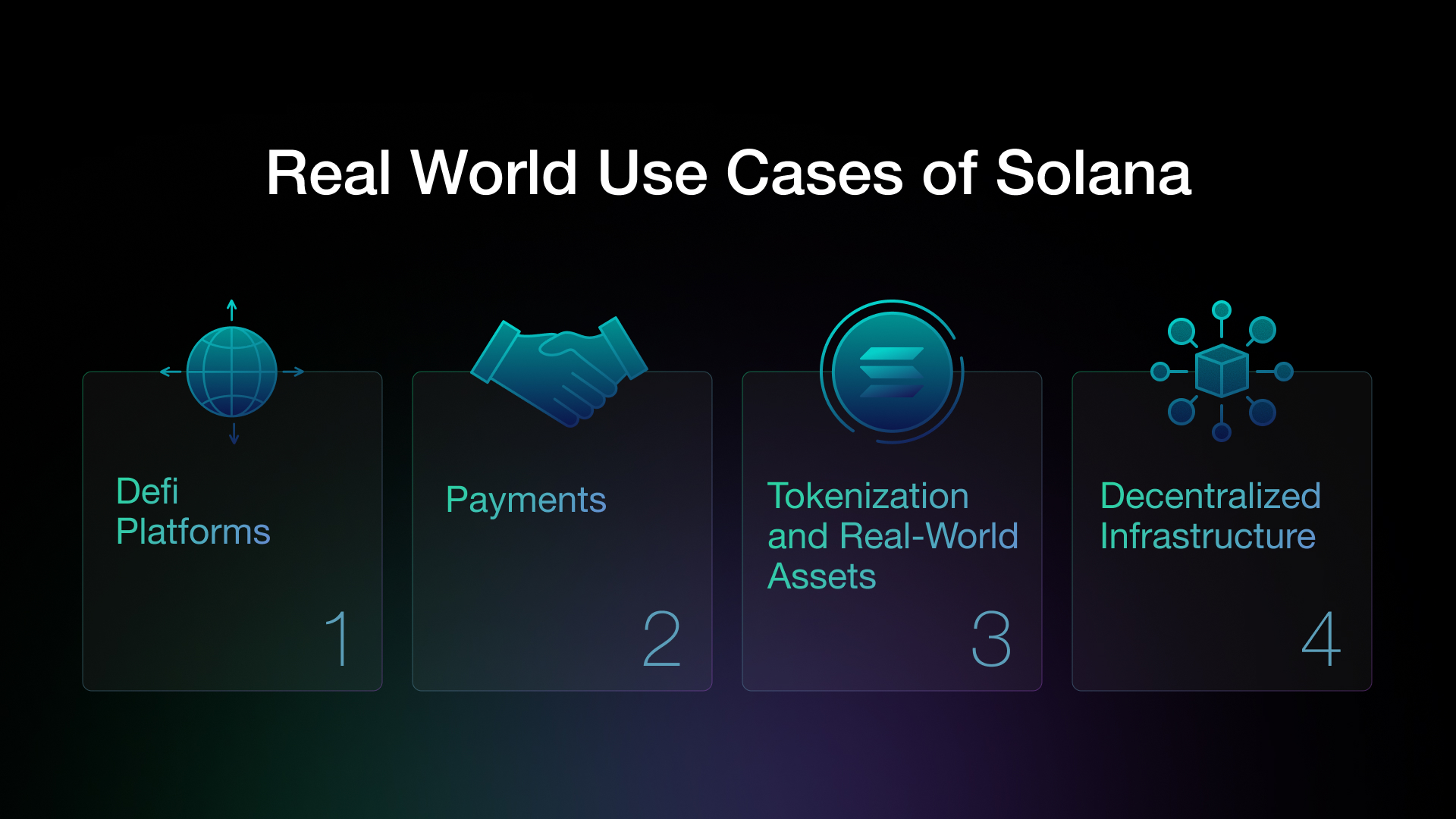
Solana’s advantages on speed, cost, and accessibility enable use cases beyond speculative crypto trading. Today, developers use Solana to reimagine traditional financial tools, coordinate real-world infrastructure, and support global payment networks.
Upgrades like Alpenglow improve reliability and throughput even further, making it easier for institutions and enterprises to build on the network.
Below are the top real-world use cases for Solana today.
Solana is one of the most active ecosystems for decentralized finance. Users can:
Traditional blockchains can take minutes to confirm a transaction and cost several dollars in fees. On slower blockchain such as Bitcoin, users might want over 20 minutes for a transaction to confirm, paying over $5 dollars in transaction fees when the network is busy. On Solana, transactions settle in under a second and cost far less than a cent, making DeFi feel like a modern internet application instead of a slow, costly clearing system.
A flagship example is Jupiter Finance, a DeFi application built on Solana offering swaps, leveraged futures, and lending. Jupiter enables users with streamlined access to decentralized finance by leveraging Solana’s speed, low fees, and community. For businesses, Solana's DeFi ecosystem offers new treasury management options. Companies can hold digital assets with greater flexibility, earning yields on reserves that would traditionally sit idle, and integrate real-time accounting into their operations. This shift shows blockchains evolving into practical infrastructure for corporate finance.
If there is one category where Solana’s speed and cost advantages are most obvious, it’s payments, especially cross-border payments.
Sending money internationally through banks typically involves multiple intermediaries, several days of processing time, and fees that can reach thousands of dollars.
On Solana, those same transfers settle in seconds, with minimal cost, regardless of destination.
This has made Solana one of the leading blockchains for remittances and consumer payments. Adoption milestones include:
The technology even enables completely new payment tools such as real-time settlement and seamless onchain disbursements, which Coinflow applies across e-commerce, fintech, gaming, marketplaces, payroll, and remittances using Solana’s speed and low fees.
Real-world asset (RWA) tokenization is one of Solana’s most transformative use cases, and one with significant institutional interest.
Tokenization enables physical assets to be represented as digital tokens with:
Real estate has become a leading early example. Properties that once required complex paperwork and high minimum investment sizes can now be tokenized, letting individuals invest with as little as a few dollars.
Ownership transfers that typically take weeks can happen in seconds via smart contracts.
Investors gain exposure to property markets previously out of reach, while property owners unlock liquidity from illiquid assets.
Beyond real estate, Solana also supports tokenization of stocks, commodities, and other assets.
Decentralized Physical Infrastructure Networks (DePINs) represent Solana's expansion into the real world. These networks coordinate real-world infrastructure using blockchain incentives instead of centralized corporations. Participants contribute physical resources such as wireless coverage, sensor data, robotics time, or energy production and receive tokens in return.
Solana's high throughput and low costs make it economically viable to coordinate and reward these many small contributions. Unlike traditional infrastructure, that requires massive capital from centralized entities, DePIN projects can scale organically through network participation.
Hivemapper shows how people can fuel a global map by driving with dash cameras and earning tokens for the imagery they capture, giving users access to fresher data than typical mapping services. Helium takes a similar approach to wireless coverage, turning everyday users into small-scale providers by rewarding those who install hotspots at home, allowing the network to expand one location at a time.
Developers consider Solana one of the most natural homes for DePIN because of predictable low fees, high throughput, and high-performance tooling.
The trajectory for Solana suggests that we’ll see continued expansion into mainstream applications as the technology matures. The blockchain's fundamental advantages: processing thousands of transactions per second, maintaining fees below a cent, and settling in under a second, create opportunities that are largely untapped. As more developers recognize these capabilities, we can expect acceleration in consumer and business applications.
Looking ahead, Solana is positioned to accelerate across consumer apps and enterprise systems. Its core strengths of sub-second confirmation, minimal fees, and global accessibility enable new categories of applications that would overwhelm other blockchains.
The combination of mobile internet access and Solana-based applications could bring financial services to billions currently excluded from the banking system. While challenges around regulation, user experience, and technical development persist, the foundation has been laid for Solana to support the next generation of decentralized applications at scale.
Solana’s main real-world uses include DeFi platforms with heavy trading activity, fast global payments supported by major companies, tokenization of assets like real estate and treasuries, and decentralized infrastructure networks for mapping and wireless services. With millions of daily transactions and quick settlement, Solana has utility well beyond just finance.
Developers pick Solana for its speed, extremely low fees, and ability to scale without relying on separate Layer 2 solutions. It supports familiar languages like Rust, C, and C++, offers native features for compliance and scaling, and has a strong developer community. This combination lets teams build applications that handle real-world demand without slowing down.
Yes, Solana works well for payments of all sizes thanks to sub-second settlement and fees far below a cent, making even tiny transactions practical. PayPal and Western Union selecting Solana for stablecoin payments reinforces its reliability for global use. The network’s speed and low cost help create a smooth experience for everyday spending.
Enterprises can build regulated products using token extensions that support transfer rules, whitelisting, confidential data handling, and built-in compliance checks. These tools operate natively on Solana, reducing the need for third-party layers. Companies can also use Permissioned Environments or integrate identity checks through transfer hooks and Civic Pass, making the platform fit regulated financial operations.
New users typically begin by installing Phantom or Solflare, which offer simple mobile and browser wallets. After creating an account, they can buy SOL through exchanges or built-in purchase tools. Clear documentation, community guides, and support channels are designed to help newcomers explore the Solana ecosystem.
Sources:
Solana origins - https://blockworks.co/news/solana-network-origins
Solana speed and capabilities - https://solanacompass.com/projects/category/rwa/payments
Solana whitepaper - https://solana.com/solana-whitepaper.pdf
Why Ethereum gas is so high - https://www.bitget.com/en-CA/wiki/why-is-ethereum-gas-so-high
Solana transaction fees - https://solana.com/tr/learn/understanding-solana-transaction-fees
Institutional interest in Solana - https://www.okx.com/en-eu/learn/solana-defi-treasury-strategies
PayPal expanding to Solana - https://newsroom.paypal-corp.com/2024-05-29-PayPal-USD-Stablecoin-Now-Available-on-Solana-Blockchain,-Providing-Faster,-Cheaper-Transactions-for-Consumers
Western Union Solana based stablecoin - https://ir.westernunion.com/news/archived-press-releases/press-release-details/2025/Western-Union-Announces-USDPT-Stablecoin-on-Solana-and-Digital-Asset-Network/default.aspx
Tokenized equities - https://solana.com/tr/tokenized-equities
Solana tokenized commodities - https://solanacompass.com/projects/elmnts
Moving from Rust to Solana - https://solana.com/pl/news/rust-to-solana
Programming languages for Solana Smart Contracts - https://www.nadcab.com/blog/supported-programming-languages-for-solana-smart-contracts
Transfer hooks and Civic Pass - https://x.com/civickey/status/1772289696355508530








© 2025 solana company. All Rights Reserved.
.svg)