

Figuring out Solana taxes doesn't have to be a headache. Whether you're swapping SOL, earning staking rewards, or just holding and selling, there are clear rules that govern how the IRS treats your activity. Here's a straightforward guide to how Solana is taxed so you can stay compliant and keep more of what you earn.
This blog post is for informational and educational purposes only and does not contain all information pertinent to an investment decision. Nothing in this blog post constitutes tax advice, legal advice, investment advice, or a recommendation of any kind.
How is Crypto Taxed?
The first thing to understand about crypto taxes in the U.S. is that the IRS doesn't treat cryptocurrency like cash, but like property. That means the same tax principles that apply to selling stocks or real estate also apply to buying, selling, and swapping crypto.
There are two main categories: capital gains taxes and income taxes.
Crypto capital gains tax applies any time you dispose of a crypto asset at a profit. Disposing means selling it for fiat, swapping it for another cryptocurrency, or spending it on goods and services. If you've held the asset for more than a year, you qualify for the lower long-term capital gains on crypto which can be 0%, 15%, or 20% depending on your income bracket. Hold it for less than a year, and short-term rates apply, which match ordinary income tax rates and can run as high as 37%.
Income taxes apply when you earn crypto. Common examples include receiving staking rewards, getting paid in SOL, or earning from yield-generating protocols. In each case, the fair market value of the tokens at the time of receipt counts as ordinary income.
However, not all crypto activity is taxable. Simply buying crypto with cash or moving tokens between wallets you own doesn't trigger a taxable event. When you sell, trade, or earn is what matters.
Careful record-keeping is essential as every transaction needs a cost basis (what you paid) and proceeds (what you received), numbers that can stack up fast across a busy Solana wallet.

When it comes to Solana tax treatment, SOL follows the same general framework as other cryptocurrencies.
If you buy SOL and later sell it for a profit, that's a capital gain. Sell for less than you paid, and that's a capital loss, which you can use to offset other gains. Hold SOL for more than a year before selling and you'll qualify for the lower long-term rate. Hold it for less, and it's taxed at ordinary income rates.
Solana's speed and low fees make it easy to move assets around quickly — but that ease of transacting doesn't mean consequence-free trading. With Solana's near-instant transfer times, it's simple to execute dozens of swaps in a single session, and each one counts as a taxable event.
Solana's unique architecture opens up a wider range of on-chain activity, and that affects how investors think about SOL as an asset — not just how it's taxed, but how Solana compares to Ethereum as a long-term hold.
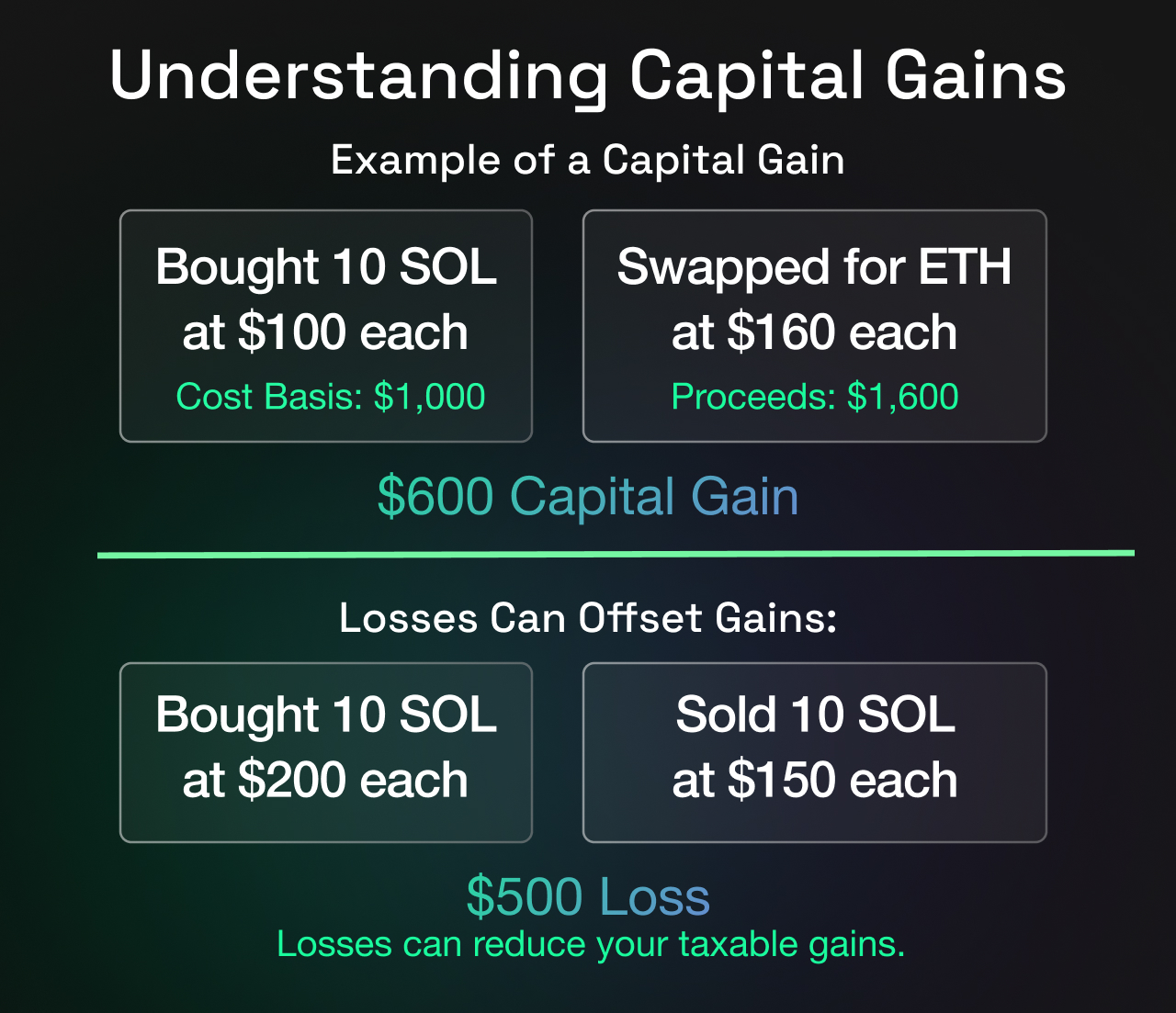
Capital gains apply any time you dispose of SOL at a price different from what you originally paid. It doesn't matter whether you sold SOL for dollars, traded it for USDC, or swapped it for another token — all of these are taxable events.
Here's a quick example: if you bought 10 SOL at $100 each and later swapped them all for ETH when SOL was trading at $160, you've realized a $600 capital gain, even though you never touched USD.
But thankfully, losses work in your favor, too. If you buy SOL at $200 and sell at $150, that $50-per-token loss can offset other capital gains on your crypto return, reducing your overall tax bill. This is sometimes called tax-loss harvesting, and it's a legitimate and widely used strategy.
One of the most important habits to build is tracking your cost basis for every SOL transaction. Cost basis is the original value you paid, including any fees. Without accurate records, you risk miscalculating your gains and potentially overpaying. This is why understanding Solana use cases and how SOL fits into a broader investment strategy matters as much as knowing the tax rules themselves
Staking rewards are taxable, and the IRS has been explicit about this since Revenue Ruling 2023-14. Under this ruling, staking rewards are treated as ordinary income the moment you gain "dominion and control" over them. In practice, that means as soon as the rewards arrive in your wallet and you're free to use or sell them, they're taxable.
The income amount is based on the fair market value of the SOL at the time of receipt. If you earn 1 SOL in rewards and it's worth $140 that day, you owe income tax on $140.
From that point, those tokens carry a cost basis of $140. If you later sell for $200, you owe capital gains tax on the $60 difference. If the price drops and you sell for $100, you have a $40 capital loss. Timing matters for both when rewards are received and when you decide to sell.
Delegators are the more common case. When you stake SOL by delegating to a validator, you earn staking rewards at the end of each epoch, or roughly every two to three days on Solana. Those rewards are taxed as ordinary income when received, based on their fair market value at that time. When you eventually sell, that becomes a separate capital gains event.
Validators have a more complex picture. Running a Solana validator node is generally treated as a business activity, which means rewards (including commission income earned on inflation rewards) may be subject to self-employment tax on top of regular income tax.
The upside is that validators may also be able to deduct qualifying business expenses like server hardware and hosting costs, depending on jurisdiction. Understanding Solana validators tax implications is important because validator income may be classified differently than passive staking rewards.
In practice, validators receive income from multiple streams: inflation rewards, Jito tips, and transaction fees. Understandably, the IRS expects all of it to be reported. If you're running a validator, working with a crypto-experienced accountant can be well worth it.
Yes, and for many investors, it simplifies things considerably. For investors exploring minimizing Solana staking tax liability strategies, structured approaches like a Digital Asset Treasury can help reduce reporting complexity.
When you hold SOL directly, every taxable event requires individual tracking and reporting. A DAT consolidates that activity under a single structure, which can reduce the recordkeeping burden significantly.
DATs typically provide consolidated statements that aggregate activity across the portfolio, making it easier to reconcile gains, losses, and income at tax time. Many also employ institutional-grade tracking systems that log cost basis, holding periods, and transaction history automatically, often the kind of documentation that individual wallet holders have to piece together manually using third-party tools.
That said, tax treatment varies depending on jurisdiction, entity structure, and how the DAT is classified. Investors should consult a qualified tax professional familiar with digital assets before drawing conclusions about their specific reporting obligations.
Yes — swapping SOL to USD is taxable. The IRS treats this as a disposal of property, which means you'll owe capital gains tax on the difference between what you received and your original cost basis. If you held the SOL for less than a year, short-term rates apply; more than a year, and you'll get the lower long-term rate.
Technically not, simply holding crypto or leaving it staked doesn't trigger a tax event on its own. But earning staking rewards does generate taxable income the moment you receive them, regardless of whether you've withdrawn or converted anything. Do you pay taxes on crypto before withdrawal? The short answer: withdrawal isn't the triggering event — receiving the rewards is.
Yes. Holding SOL inside a digital asset treasury (DAT) shifts reporting responsibility to the corporate entity, often resulting in more streamlined tax management. You'll still owe taxes on gains and income, but a DAT structure typically comes with better record-keeping infrastructure, consolidated reporting, and institutional-level oversight compared to managing individual wallets.
This blog post is for informational and educational purposes only and does not contain all information pertinent to an investment decision. Nothing in this blog post constitutes tax advice, legal advice, investment advice, or a recommendation of any kind. Solana Company is not a tax advisor, investment advisor, or registered investment company, and an investment in Solana Company does not provide the protections of the Investment Company Act of 1940.
The tax-related information discussed in this blog post is general in nature and is based on U.S. federal tax concepts as understood at the time of publication. Tax laws, IRS guidance, and regulatory interpretations related to digital assets, including Solana (SOL), are evolving and subject to change without notice. The tax treatment of digital assets may vary significantly depending on individual circumstances, including but not limited to filing status, holding period, cost basis methodology, state of residence, and other factors. Nothing in this blog post should be interpreted as a definitive statement of tax law or a substitute for personalized guidance from a qualified tax professional, CPA, or tax attorney.
This blog post contains information believed to be reliable, and has been obtained from sources believed to be reliable, but Solana Company makes no representation or warranty (express or implied) of any nature, nor accepts any responsibility or liability of any kind, with respect to the fairness, accuracy, completeness, or reasonableness of the information or opinions contained herein. There is no guarantee that investments in any company, instrument, or type of instrument described herein will be profitable – all investments carry the inherent risk of total loss. Analyses and opinions contained herein (including market commentary, statements or forecasts) reflect the judgment of Solana Company as of the date this blog was published, and may contain elements of subjectivity (including certain assumptions) or be based on incomplete information. There is no duty or obligation to update the contents of this blog post. This blog post is not intended to provide, and should not be relied on for accounting, legal, or tax advice, or investment recommendations. There is no guarantee that investments in any instrument or type of instrument described herein will be profitable – all investments carry the inherent risk of total loss.









© 2025 solana company. All Rights Reserved.
.svg)