

Digital assets aren't just for crypto natives anymore. A new investment category is emerging that connects Wall Street with Web3, creating opportunities that didn't exist just a few years ago.
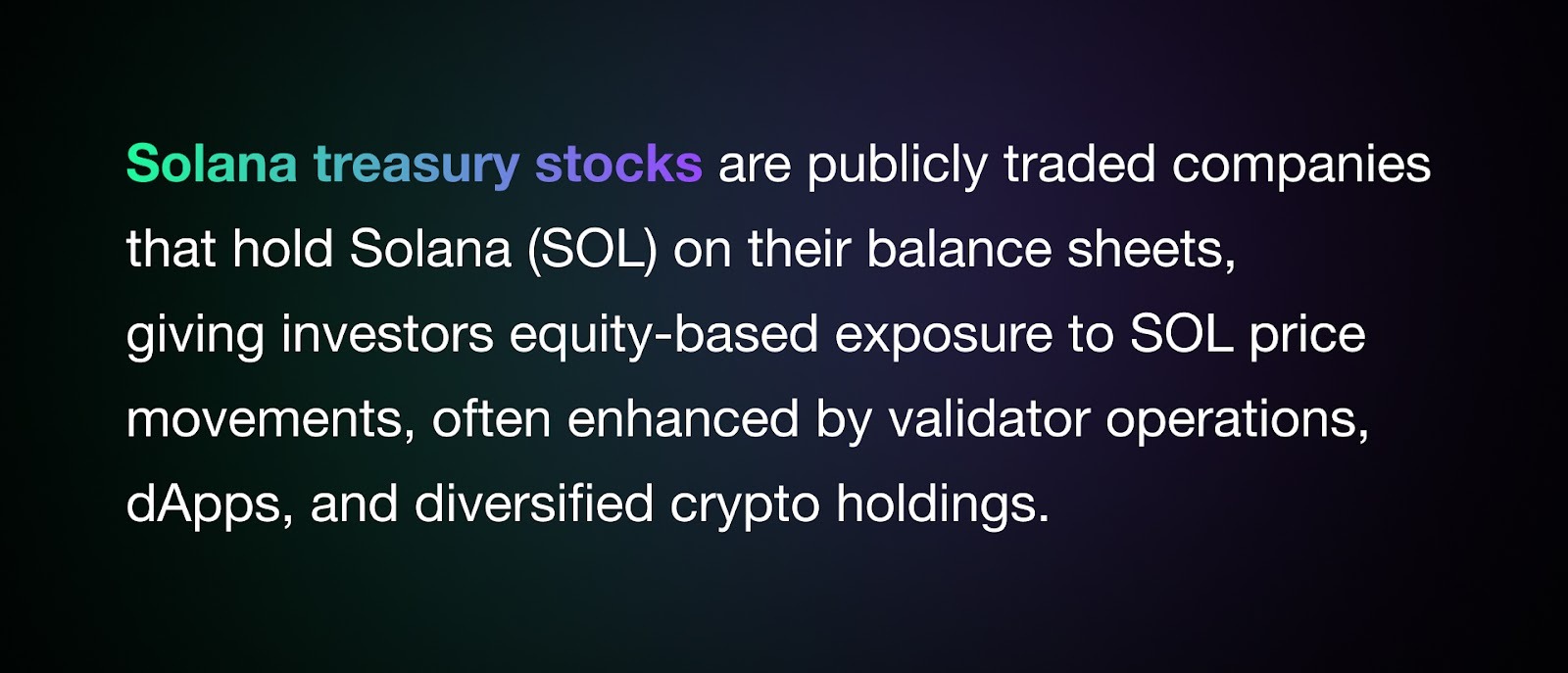
Solana treasury stocks represent ownership in publicly traded companies holding Solana’s native token (SOL) on their balance sheets. They serve as an alternative way to gain Solana-based performance through traditional investment channels.
Knowing about Solana treasury stocks is central to recognizing where institutional capital is moving next.
When Strategy (formerly known as MicroStrategy) announced its plans to start buying Bitcoin in 2020, it changed how companies think about their cash reserves. What started as a bold experiment quickly became the new normal, with governments and dozens of publicly traded companies now holding digital assets as reserves.
As Bitcoin treasury adoption matured, forward-thinking firms began exploring other blockchain networks. Solana entered with exceptional transaction speed, minimal fees, and one of the fastest growing ecosystems in Web3.
The emergence and growth of Solana treasury companies is part of this continued evolution, combining financial strategy with forward thinking and innovation.
Solana treasury stocks are shares in publicly traded companies holding SOL on their balance sheet. Think of them as the equity version of cryptocurrency investing; you're essentially buying stock in companies whose value is tied to their Solana holdings.
Solana Digital Asset Treasuries (DATs) focus exclusively on accumulating SOL as their core model. They raise capital by selling stock to purchase tokens, creating exposure to SOL price movements so their stock performance closely tracks Solana's trajectory. Companies like DeFi Development Corp and Upexi have built positions exceeding 2 million SOL tokens valued at hundreds of millions of dollars.
Many treasuries hold SOL while also operating validator nodes, developing decentralized applications (dApps), or providing essential services within the Solana ecosystem. Sol Strategies, for example, runs multiple validators and manages stakes from institutional investors while growing its reserves; a dual approach that provides two sources of revenue.
A diversified DAT may hold a basket of cryptocurrencies, including core assets like Bitcoin and Ethereum, with Solana as a significant component. By spreading risk across multiple networks, DATs offer investors a single diversified equity investment vehicle.
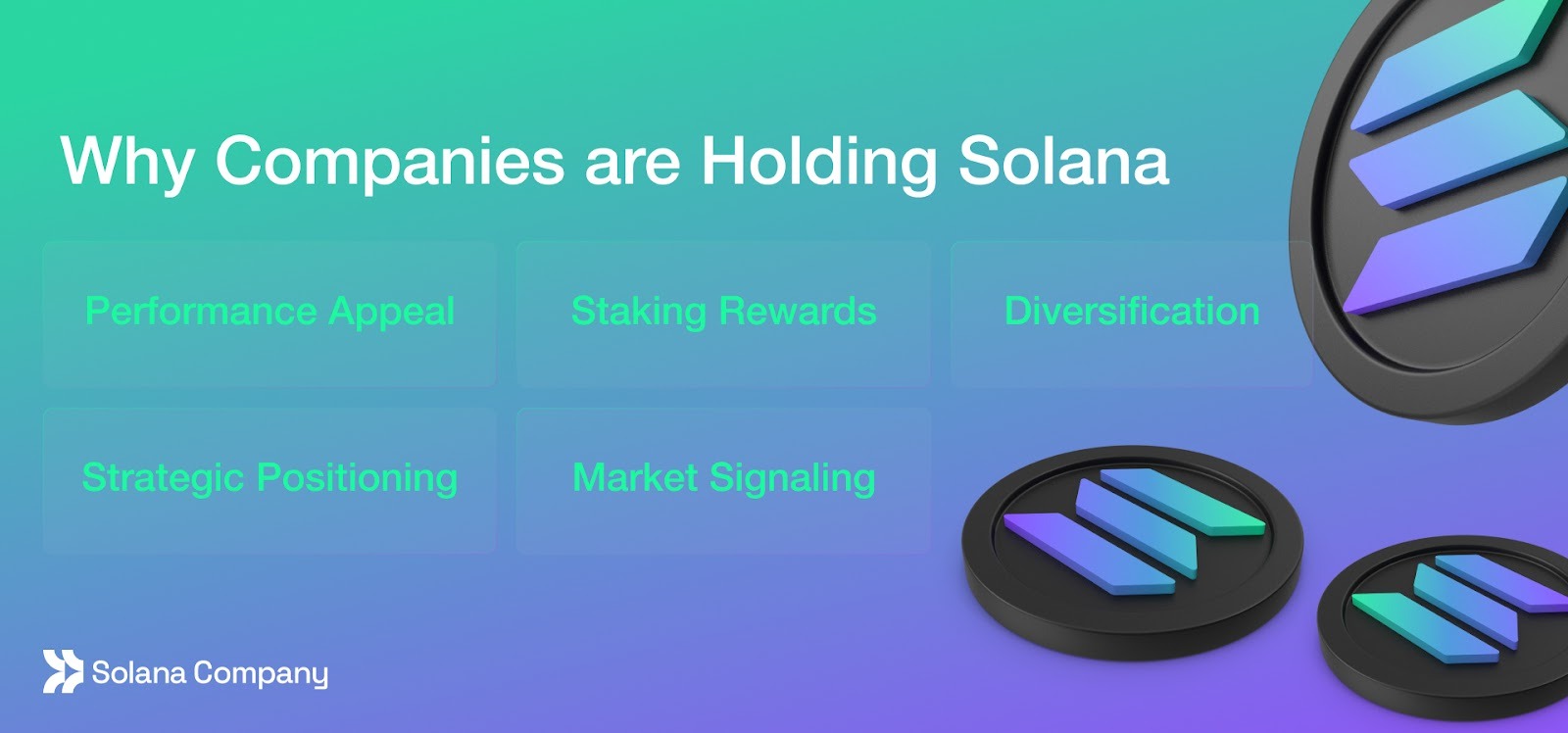
Solana excels in a few areas that treasury teams care about. The proof-of-stake (PoS) protocol means companies can earn passive income on their holdings—something you can't do with proof-of-work (PoW) assets. That turns SOL holdings into productive capital with returns that finance teams can build into their projections.
There's also the risk angle. If your treasury is all-in on one blockchain, you're fully exposed to whatever happens to that specific network. Bringing in assets with different technical designs, consensus models, and use cases helps spread that risk around. But companies should balance these diversification upsides against the headache of managing positions across different cryptos.
Getting in early on emerging infrastructure networks can also set up a company for valuable market advantages before everyone else catches on. Moves like this look past short-term gains toward long-term ecosystem involvement.
With those factors in mind, the next question becomes how Solana has held up in practice—and whether its track record justifies a treasury allocation.
Solana has performed well following a difficult period. Three outages in March - September of 2022 and the FTX debacle in November 2022 hurt its price but institutional adoption accelerated in 2024-2025. The network processed billions of transactions while maintaining its low fees and high throughput. Digital assets may be much more volatile than stocks and bonds but by allocating portions of balance sheets to SOL, firms can profit from the upside typical of early-cycle high-growth assets.
Unlike Bitcoin, holding SOL generates passive income through staking rewards. The network operates on proof-of-stake consensus, paying validators and delegators for securing the blockchain. Current yields are around 6% annually—substantial returns when traditional fixed-income offers minimal yields. Companies can stake holdings directly with validators or through liquid staking protocols, earning rewards that compound over time.
For firms holding tens of millions in SOL, these returns mean revenue that can fund business growth or for further SOL accumulation and it’s an advantage that becomes particularly attractive in low-interest-rate environments. It turns Solana into a productive treasury holding generating ongoing cash flow through staking.
Holding exclusively traditional assets exposes companies to inflation risk and limited upside. For companies already holding Bitcoin or Ethereum, SOL introduces different blockchain architecture with distinct characteristics. Different chains deal with different risks (regulatory headaches, technical hiccups, etc.) and spreading across a few of them means you're not putting all your eggs in one blockchain basket.
Many companies view investing in SOL as a strategic move. Holding it signals ecosystem commitment, opening doors to partnerships and business opportunities. Companies operating validators gain influence over network development.
This positioning strengthens long-term planning by giving treasuries early exposure to a network that may support some of the world’s major financial and consumer applications in the future. Companies such as Render Network (decentralized computing power) and Helium (decentralized wireless infrastructure), are already building applications on the Solana blockchain and as the ecosystem grows, these holdings give Solana treasury stock investors exposure to more opportunities.
When companies announce treasury strategies, they send powerful signals. These announcements often trigger stock price appreciation as investors recognize dual exposure. Corporate adoption validates Solana's technology, reducing perceived risk and attracting further institutional interest.
These signals also shape expectations about the company’s adaptability. Investors often interpret early Solana holdings as evidence that a DAT is preparing for future participation in digital asset markets.
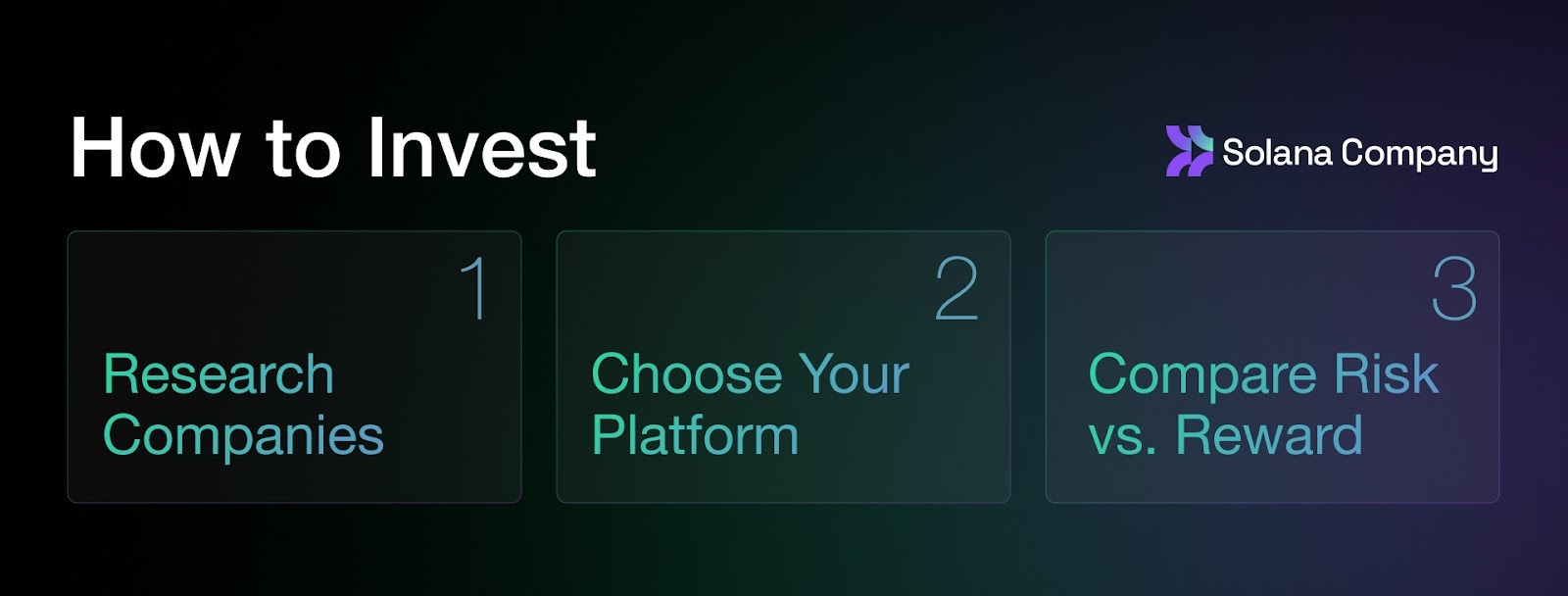
Start with public filings, they're your best window into how a company is building its SOL position and whether the strategy makes sense long-term. Not all treasury companies are created equal, so you'll want to dig into the fundamentals before committing.
Some key things to check when researching Solana treasury stocks are:
Major players trade on NASDAQ, so you can pick them up through any standard brokerage such as Fidelity, Schwab or Robinhood. Others trade on over-the-counter markets so you’ll need a brokerage that supports OTC trading to buy them.
These stocks come with high volatility—when SOL appreciates, they often gain even more, but the same leverage works against you during corrections. Regulatory uncertainty remains an ongoing consideration, and dilution is worth watching since many companies fund their SOL purchases through equity offerings. Pay attention to how management handles capital allocation and their track record on shareholder dilution.
Solana treasury stocks give you a way to get crypto exposure without leaving the familiar world of stocks and brokerages. Here's what makes them appealing:
The Solana treasury movement remains in its early stages, with current holdings representing a small fraction of total supply. There’s plenty of room for growth in Solana treasury stocks if corporate demand continues accelerating and several catalysts could drive the next adoption wave.
Bitcoin treasury companies were rare until 2020, but the concept spread to dozens of firms. If Solana follows a similar trajectory, the number of Solana stocks could grow over the coming years.
Challenges remain around regulatory clarity, market volatility, and competitive dynamics. Regulatory treatment of cryptocurrency classification, taxation, and securities will influence how aggressively companies pursue strategies.
Despite uncertainties, Solana stocks represent an innovative convergence of traditional markets and blockchain technology, providing exposure while positioning companies well for the future growth of the digital economy.
Solana treasury stocks are shares in public companies that hold SOL as an asset but are still regular stocks governed by standard securities rules. Traditional stocks get their value from their business operations, while these derive much of their value from crypto holdings. It's a way to get crypto exposure through a regulated wrapper, with different tax treatment, custody, and liquidity than if you just bought SOL directly. You own equity in the company, not the tokens themselves.
Most companies buy through OTC deals or gradual accumulation to avoid moving the market. That said, sustained buying from multiple treasuries can still tighten circulating supply and push prices up—especially when staked tokens get locked away. All that staking activity also affects network security and how rewards flow to validators.
New FASB rules (effective for fiscal years starting after December 15, 2024) require companies to mark their crypto holdings to fair value each period, with gains and losses hitting net income. That's a big upgrade from the old approach, which only let companies recognize losses—never gains. SOL holdings now get reported separately from other intangibles, giving investors a clearer picture of what's actually on the balance sheet.
Yes. Companies can stake through institutional custodians like Coinbase Prime, Anchorage Digital, or Fireblocks—all of which offer enterprise-grade security with multi-sig setups and insurance. Liquid staking is another option, where companies get a tokenized version of their holdings while the underlying SOL earns rewards in the background.
There are guardrails in place. Boards typically sign off on major treasury decisions, and companies must file regular disclosures detailing their holdings. Custody setups prevent anyone from moving assets unilaterally, while external auditors verify everything annually. On top of that, securities regulators are watching, and insider trading rules apply just like with any other public stock.
This blog is for informational purposes only and does not contain all information pertinent to an investment decision. Nothing in this blog constitutes an investment recommendation or an offer of investment advisory services. This blog cannot be relied upon in making an investment decision. Nothing contained herein constitutes an offer to sell, or a solicitation to buy, any securities. This blog contains information Pantera believes to be reliable, and has been obtained from sources believed to be reliable, but Pantera makes no representation or warranty (express or implied) of any nature, nor accepts any responsibility or liability of any kind, with respect to the fairness, accuracy, completeness, or reasonableness of the information or opinions contained herein. Analyses and opinions contained herein (including market commentary, statements or forecasts) reflect the judgment of Pantera as of the date this blog was published, and may contain elements of subjectivity (including certain assumptions) or be based on incomplete information.








© 2025 solana company. All Rights Reserved.
.svg)