
Corporate treasuries are rethinking how they hold digital assets. While Bitcoin dominated early adoption, newer blockchains like Ethereum and Solana are becoming more popular as holdings for organizations that want to generate income and gain exposure to digital assets
Ethereum established itself as the institutional favorite years ago, but Solana's growing momentum, primarily driven by dramatically lower costs and faster transactions, offers new opportunities.
Tokenization will likely reshape financial markets in the next decade, so understanding how these two networks compare as treasury assets is essential for CFOs and treasury managers.
The decision between Solana and Ethereum isn't about which blockchain is subjectively better; it's about which one aligns best with your organization's treasury strategy and goals. Both networks offer staking yields, liquid secondary markets, and exposure to Web3 growth, but they serve different needs and risk profiles.
Crypto treasuries must evaluate these technologies not just as speculative assets, but as functional infrastructure to support:
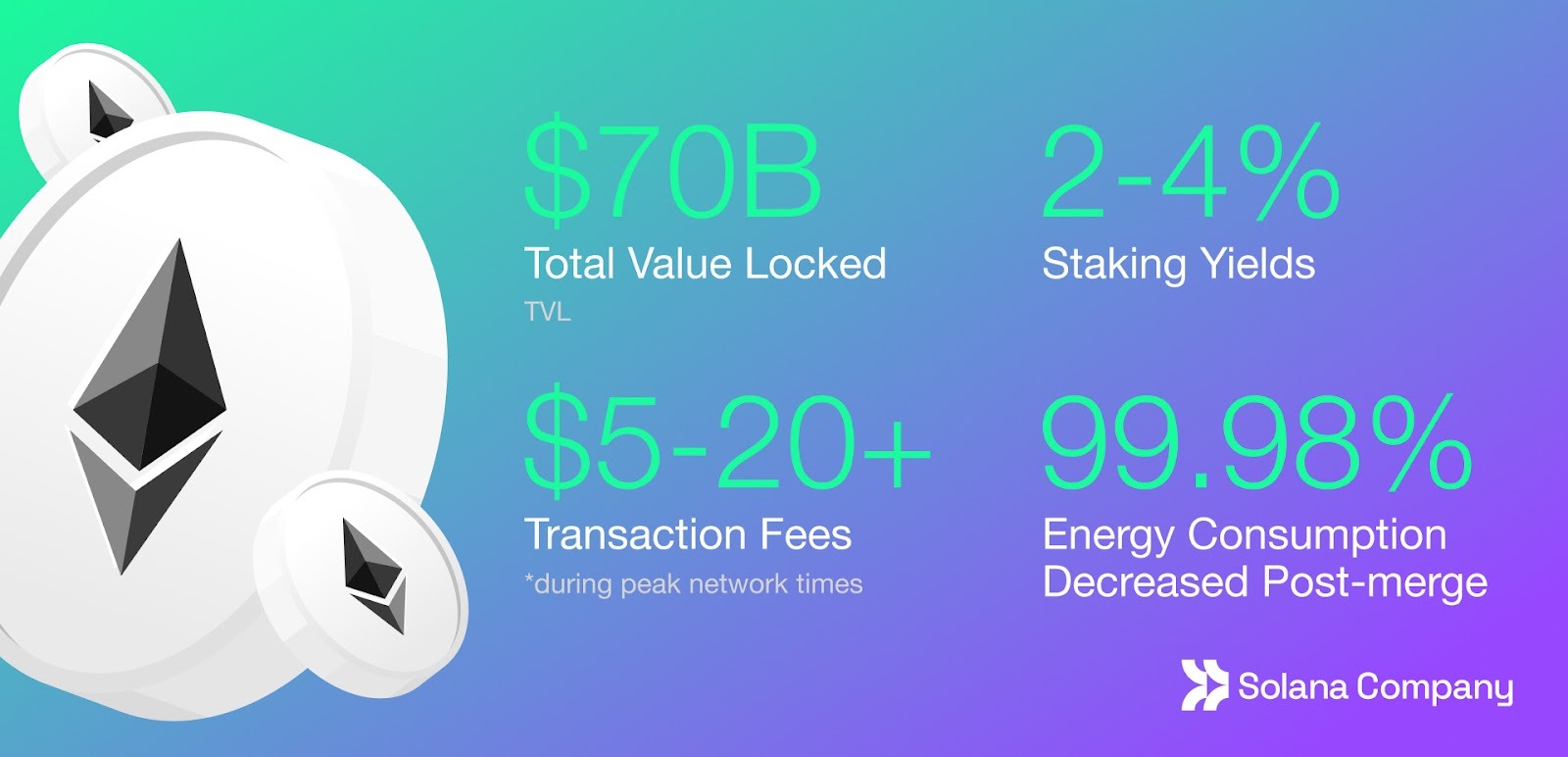
Ethereum is strongly allocated in the balance sheets in crypto portfolios. As the first programmable blockchain to achieve mainstream adoption, it's become a commonly used platform for decentralized finance, with about $70 billion in total value locked (TVL) across its ecosystem. This maturity means investors get access to deep liquidity and widespread acceptance among institutional investors, even more so now with the release of Ethereum ETFs and DATs.
From a treasury perspective, Ethereum offers relative stability compared to other cryptos. Its proof-of-stake (PoS) consensus mechanism, fully operational since “The Merge” in September 2022, enables staking yields of 2-4% without sacrificing liquidity through liquid staking derivatives. Major corporations like Coinbase have allocated portions of their treasuries to Ethereum, viewing it as programmable infrastructure rather than just a speculative asset. The network processes about 1.5 million transactions a day and is the largest blockchain ecosystem by active developers and applications.
However, Ethereum's treasury appeal comes with costs. Transaction fees can spike to $5-20+ during network congestion, making frequent on-chain activity expensive. Layer 2 scaling solutions like Arbitrum and Optimism help, but they fragment liquidity and add a bit of extra complexity for businesses. Energy consumption decreased by about 99.98% post-Merge, but validator requirements require some technical expertise.
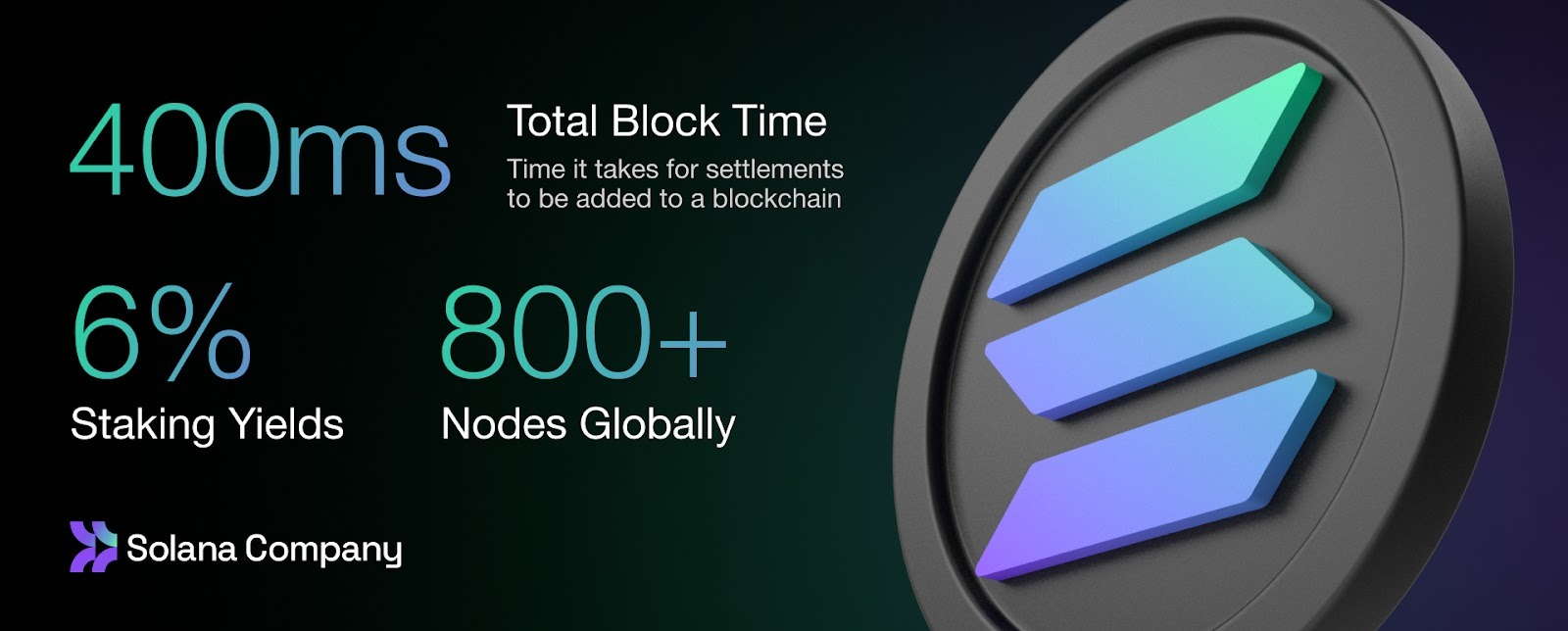
Solana was first released in March 2020, five years after Ethereum and gaining momentum rapidly. Its proof-of-history (PoH) architecture enables a block time (the time it takes for settlements to be added to a blockchain) of roughly 400 milliseconds with fees consistently under $0.01—a major advantage for organizations executing high-frequency on-chain activity and particularly attractive for companies building platforms to tokenize real-world assets or create payments infrastructure.
Solana’s treasury appeal extends beyond speed and cost. Solana's staked validator set exceeds 800 nodes globally, and its staking yields hover around 6%—higher than Ethereum's 2-3%. Projects like Ondo Finance use Solana for tokenized treasury products, and the growing number of institutions holding Solana suggests confidence in the network's stability and long-term prospects.
While Solana experienced network outages in its early years with the most recent outage on February 6, 2024 , though stability has improved significantly with recent upgrades and has not experienced network downtime since. Running an individual validator on Solana requires steeper hardware requirements but staking SOL can be simple by leveraging the Solana ecosystem with validators like Helius and Jito Market volatility also runs higher; SOL's price swings can be more dramatic than ETH's, requiring stronger risk management protocols.
For a faster platform, Solana treasuries offer compelling benefits that Ethereum can't match on cost or throughput alone.
This comparison highlights the core trade-off when it comes to Ethereum and Solana: Ethereum offers safety through proven stability and more established institutional infrastructure, while Solana delivers efficiency through low costs and high throughput.
Corporate blockchain treasuries are evolving beyond simple buy-and-hold strategies. Financial institutions and central banks are actively researching tokenization frameworks, with the IMF saying that tokenized assets could address market inefficiencies in settlement and custody. The Bank for International Settlements similarly highlights tokenization's potential to transform financial infrastructure. As these systems mature, we may begin to see treasuries not only holding crypto but actively using it for yield generation and tokenization of real-world assets.
Both Ethereum and Solana are positioned to benefit from this shift, though in different ways. Ethereum's (for now) larger ecosystem and regulatory familiarity make it the traditional platform for financial institutions experimenting with tokenization. Solana's speed and cost advantages position it for use cases where high transaction volume matters.
Solana Company's focus on enterprise-grade infrastructure and network stability supports this trajectory, helping organizations confidently integrate Solana into their treasury operations without sacrificing reliability. The future is about understanding which blockchain is the best solution to a given problem.
Ethereum uses proof-of-stake with blocks being validated and added to the blockchain every 12 seconds, while Solana relies on proof-of-history which builds timestamps into the blockchain itself via a verifiable delay function (VDF). That timestamping unlocks parallel execution and much higher throughput. Ethereum scales mainly through Layer 2 rollups, such as Optimism, that push computation off-chain, but Solana focuses on scaling directly at the base layer with stronger hardware and efficient networking. Ethereum also requires 32 ETH to run a validator, while Solana has no minimum.
Solana delivers lower fees and near-instant confirmation, usually settling transactions in under a second at a cost well below one cent. Ethereum remains more expensive with transaction times of about 12 seconds. Confirmation times also fluctuate based on network activity. Rollups help reduce typical Ethereum costs, but they still don’t match Solana’s speed or consistency. For users prioritizing quick settlement and predictable fees, Apps with frequent or high-volume activity are smoother on Solana.
Ethereum benefits from a long record of stable operation, with nearly a million validators and flexible client implementations to reduce single-point failures. Solana handles far more transactions, which exposes a wider surface area, and although it’s had none recently, it has had outages in the past. Solana runs around 800-900 validators and requires better hardware, influencing who can participate. Both platforms invest heavily in audits and bounty programs.
Ethereum leads in tooling variety and depth. Hardhat, Foundry, Remix, and OpenZeppelin give developers reliable frameworks for audits, testing, and deployment. Its Ethereum Virtual Machine (EVM) powers countless Layer 2 networks and sidechains, making interoperability straightforward. DeFi, NFT infrastructure, and enterprise projects typically launch there first. Solana’s ecosystem is improving fast, with Rust attracting developers from traditional software backgrounds and frameworks like Anchor making smart contract development easier.
Ethereum is often the better fit for applications that rely on deep DeFi composability, strong institutional support, or user bases already active in the EVM world. It’s well suited for on-chain financial products, treasury infrastructure, and governance systems. Solana shines when cost and speed drive the user experience—payment networks, social apps, gaming, and any idea requiring rapid interactions.
This post is made available by Pantera Capital Partners LP (“Pantera”) for informational and educational purposes only. It does not contain all information pertinent to an investment decision. Nothing in this blog constitutes an investment recommendation or an offer of investment advisory services. This blog cannot be relied upon in making an investment decision. Nothing contained herein constitutes an offer to sell, or a solicitation to buy, any securities. This blog post contains information Pantera believes to be reliable, and has been obtained from sources believed to be reliable, but Pantera makes no representation or warranty (express or implied) of any nature, nor accepts any responsibility or liability of any kind, with respect to the fairness, accuracy, completeness, or reasonableness of the information or opinions contained herein. Forward-looking statements should not be relied upon. There is no guarantee that investments in any instrument described herein will be profitable – all investments carry the inherent risk of total loss. Analyses and opinions contained herein (including market commentary, statements or forecasts) reflect the judgment of Pantera as of the date this blog was published, and may contain elements of subjectivity (including certain assumptions) or be based on incomplete information. Pantera has no duty or obligation to update the contents of this blog post. This blog post is not intended to provide, and should not be relied on for accounting, legal, or tax advice, or investment recommendations. Pantera and its principals have made investments in some of the instruments discussed in this communication and may in the future make additional investments or trading decisions in connection with such instruments without further notice.



.svg)