
Digital assets like Bitcoin and Solana are moving into traditional finance. Investors now see blockchain networks as an asset class that can be used to generate income and grow capital over time, rather than just a new technology.
Bitcoin has dominated the conversation, but Solana is rapidly emerging as a contender, offering different capabilities and more transactions on it than all other blockchains combined.
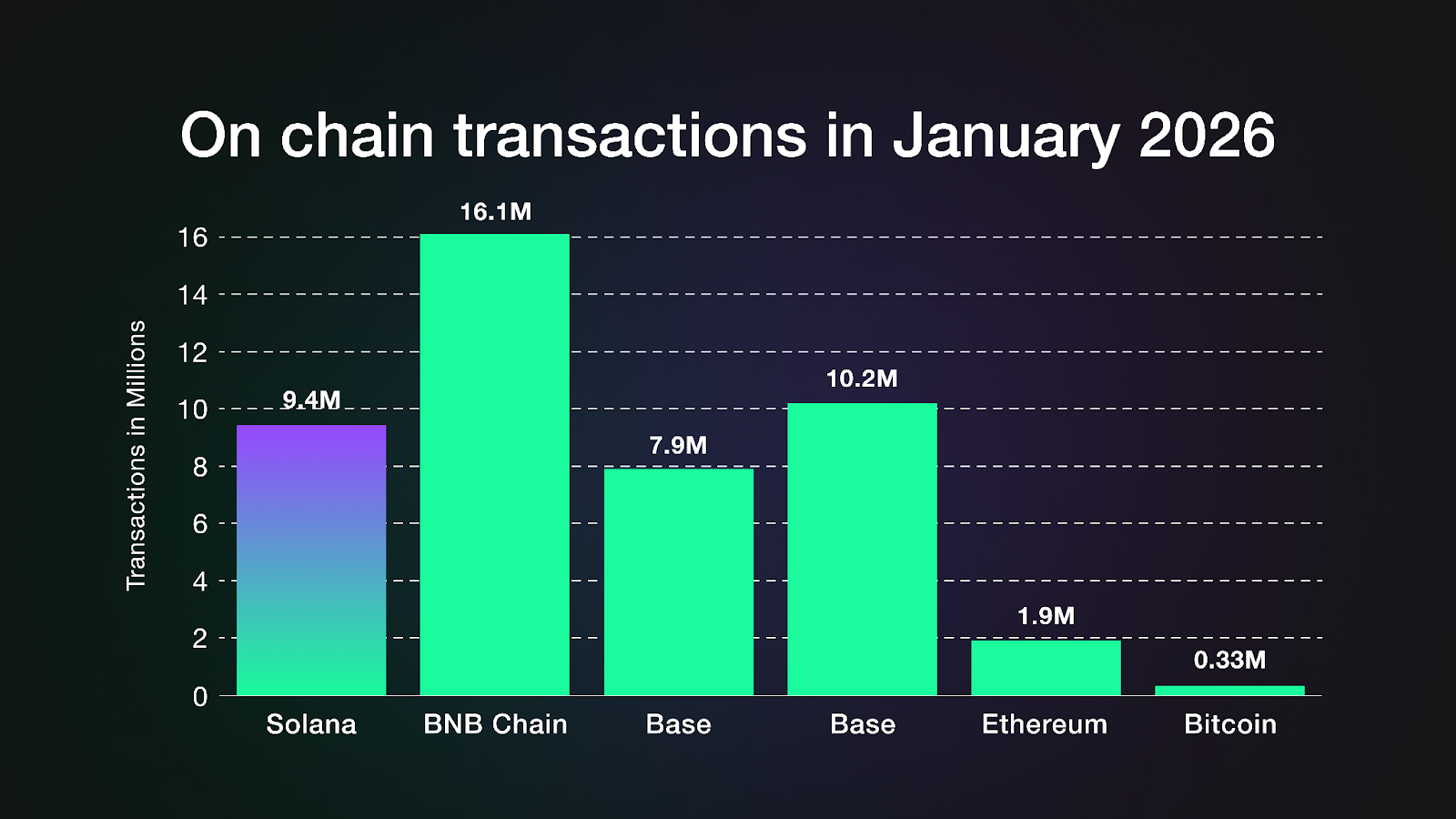
On chain transactions in January 2026:
Rather than just being bought by people to buy and hold, Solana is becoming the place where most on-chain activity happens. If you're evaluating digital assets for your treasury, understanding the differences between Solana and Bitcoin is key.
More and more companies, funds, and governments are exploring crypto for their treasuries. Companies now hold billions in digital assets on their balance sheets, with Bitcoin dominating these allocations.
But things are changing and traditional finance (TradFi) is finally catching on that not all blockchains are created equal. Bitcoin and Solana take completely different approaches to the digital asset ecosystem.
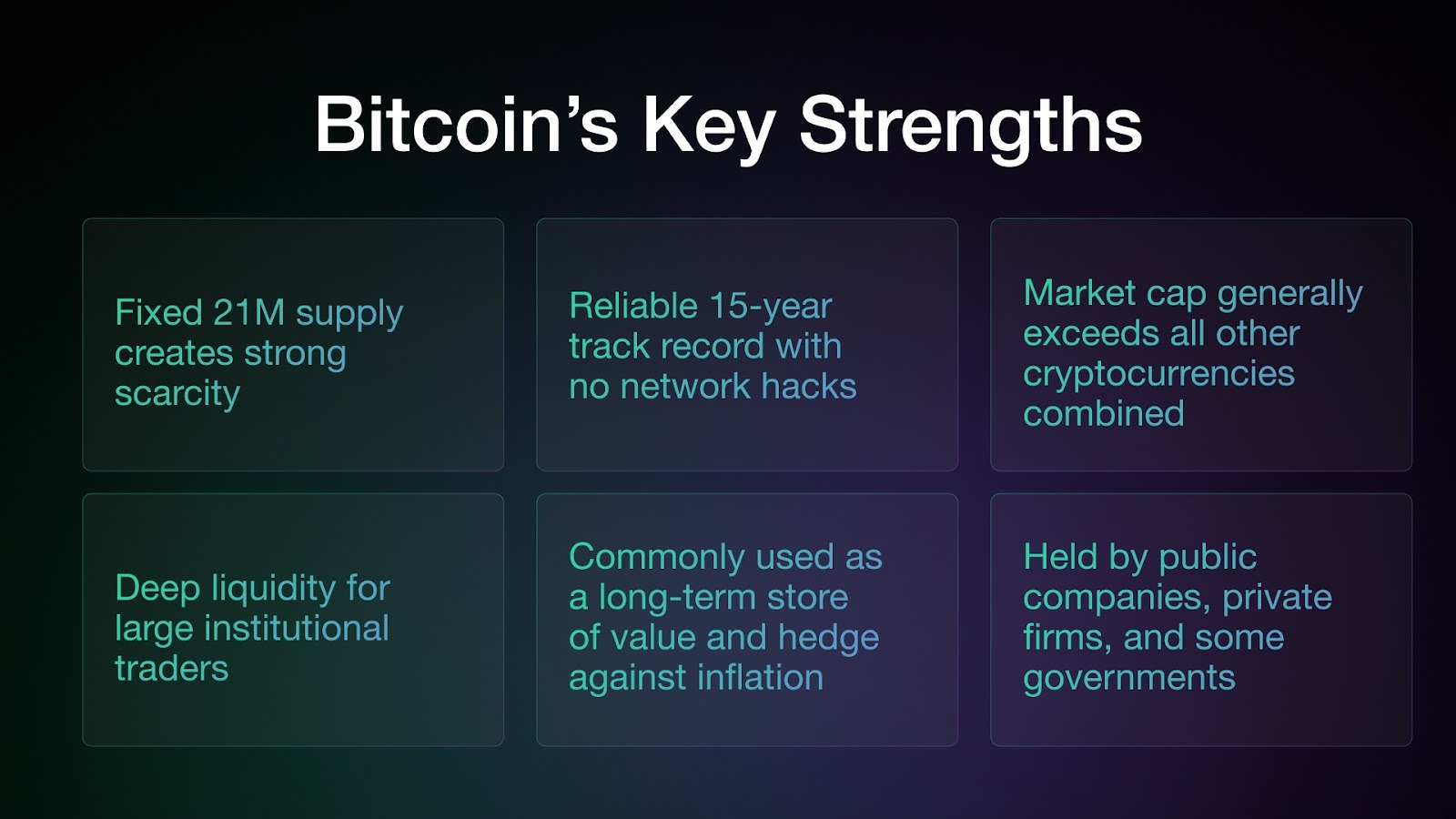
Since Satoshi Nakamoto published the Bitcoin whitepaper in 2008, it has evolved into a widely recognized store of value, often referred to as "digital gold." This narrative and its longevity has driven wider treasury adoption, with public and private institutions accumulating substantial Bitcoin reserves.
Publicly traded companies have added Bitcoin to their balance sheets as a long-term value preservation strategy, viewing it as superior to holding cash with inflation on the rise. Initial early adopters have been joined by more firms across a range of industries, with some jurisdictions even exploring Bitcoin as a sovereign reserve asset.
Despite its popularity, Bitcoin faces limitations as a treasury asset. The network's limited programmability and scripting language restricts its use beyond value storage and transfer. Like all digital assets, Bitcoin also exists in a legal and regulatory landscape that is changing fast and varies considerably around the world.
Unlike Bitcoin's focus on payments, Solana was built as a platform for decentralized applications (dApps), finance protocols, and programmable digital assets. This makes it highly appealing as a treasury asset.
The biggest challenge facing Solana as a treasury asset is its youth compared to Bitcoin – Solana has been around for 5 years, Bitcoin for over 15. Solana has also experienced several outages and its market capitalization and liquidity remain significantly below Bitcoin's, potentially limiting the amount anyone can invest in one go.
Solana and Bitcoin aren't really competitors but are complementary tools in your treasury toolkit. Bitcoin excels as a long-term store of value with maximum security and liquidity. Solana provides exposure to a newer asset with wider applications. Some treasuries hold both assets, allocating based on specific strategic objectives and risk parameters.
Digital treasury management is still evolving as blockchain tech matures and more institutions jump in. In the future, rather than seeing one declared the “winner,” we’ll likely see multiple networks, each doing what it does best.
Bitcoin's role as a reserve asset appears increasingly established, with growing regulatory clarity and corporate acceptance. While Ethereum maintains its position as the leading smart contract platform, Solana vs. Ethereum presents another important comparison for treasuries looking to invest in programmable blockchain infrastructure.
Solana's trajectory depends on its continued network reliability and scalability as adoption grows. The platform's low costs and high throughput position it well for operational treasury use cases, particularly as DeFi applications mature. Organizations like Solana Company play a crucial role in this evolution by supporting ecosystem development, fostering institutional-grade infrastructure, and bridging traditional finance with blockchain innovation.
As crypto investing strategies become more sophisticated, the question digital asset treasuries face is changing from "Bitcoin or alternatives?" to "How can different blockchain assets work together in a digital asset treasury portfolio?"
Bitcoin solves digital scarcity and trustless value transfer by creating money that can't be inflated, seized, or controlled by central authorities. It functions as a censorship-resistant store of value. Solana tackles performance limits that stop blockchains from supporting real applications. With high throughput and tiny fees, it enables real-time finance, consumer apps, and on-chain activity that would be too slow or expensive on earlier networks.
Bitcoin handles around seven transactions per second, with confirmations often taking 10–60 minutes and fees rising sharply during congestion. Solana supports thousands of transactions per second, reaches finality in under a second, and keeps fees well below a cent. These differences make Solana far better for high-volume or interactive applications, while Bitcoin remains focused on secure settlement.
Yes, Bitcoin liquidity reaches Solana through bridges and wrapped BTC tokens, known as WBTC. The process locks BTC on Bitcoin and issues a matched token on Solana, letting users trade, lend, or supply liquidity within Solana’s DeFi ecosystem while keeping exposure to Bitcoin’s value. This gives BTC holders access to fast, low-cost transactions, though bridges bring added security assumptions that users should weigh carefully.
Solana is much better suited for building applications. Bitcoin’s base layer intentionally limits programmability to keep monetary transfers simple and secure, making complex dApps impractical. Solana was engineered for smart contracts, offering fast execution, low fees, and strong developer support. That foundation enables advanced DeFi protocols, NFT markets, and consumer apps that depend on speed and affordability.
Bitcoin’s thesis centers on becoming digital gold: a scarce, neutral asset used as a store of value and macro hedge. Its appeal comes from predictable supply, strong security, and institutional acceptance. Solana’s thesis centers on adoption of high-speed on-chain applications. Investors see value accruing as more activity, developers, and users rely on the network. Bitcoin attracts those seeking long-term monetary stability; Solana draws believers in blockchain-powered software.
This blog post is made available by Pantera Capital Partners LP and its affiliates (“Pantera”) for informational and educational purposes only. This blog post does not contain all information pertinent to an investment decision. Nothing in this blog post constitutes an investment recommendation or an offer of investment advisory services. This blog post cannot be relied upon in making an investment decision. Nothing contained herein constitutes an offer to sell, or a solicitation to buy, any securities. This blog post contains information believed to be reliable, and has been obtained from sources believed to be reliable, but Pantera makes no representation or warranty (express or implied) of any nature, nor accepts any responsibility or liability of any kind, with respect to the fairness, accuracy, completeness, or reasonableness of the information or opinions contained herein. Forward-looking statements (including predictions) should not be relied upon. There is no guarantee that investments in any instrument or type of instrument described herein will be profitable – all investments carry the inherent risk of total loss. Analyses and opinions contained herein (including market commentary, statements or forecasts) reflect the judgment of Pantera as of the date this blog was published, and may contain elements of subjectivity (including certain assumptions) or be based on incomplete information. There is no duty or obligation to update the contents of this blog post. This blog post is not intended to provide, and should not be relied on for accounting, legal, or tax advice, or investment recommendations. Pantera and its principals have made investments in some of the instruments discussed in this communication and may in the future make additional investments or trading decisions in connection with such instruments without further notice.





.svg)